

Quick answer
Call Triple Zero (000) and ask for an ambulance whenever someone is unconscious, is having trouble breathing, has chest pain, is bleeding heavily, shows signs of a stroke, has a seizure lasting more than 5 minutes, or has a severe allergic reaction. Say “ambulance” when the operator answers, then be ready with what has happened, where you are, the patient’s age, and whether they are breathing and conscious. Stay on the line — the call taker will tell you what to do until paramedics arrive.
If you are not sure, call 000. Emergency call takers would far rather talk you through a situation that turns out to be minor than have you wait on a serious one. You will never be in trouble for calling.
Most people only call an ambulance once or twice in their life, and it is almost always on the worst day they have had. Knowing what happens on that call — what you will be asked, and what you can have ready — makes a real difference to how fast the right help arrives.

Dial 000 and ask for an ambulance. Stay on the line — the call taker will guide you.
When should you call an ambulance?
Call Triple Zero (000) immediately if the person has any of the following:
- Is unconscious or cannot be woken
- Is not breathing, or is having real difficulty breathing
- Chest pain or chest tightness, especially if it spreads to the arm, neck or jaw
- Signs of a stroke — use the FAST check: Face drooped, Arms cannot be raised, Speech slurred, Time is critical
- Severe bleeding that does not slow with firm pressure
- A severe allergic reaction — swelling of the face or tongue, difficulty breathing, collapse. See anaphylaxis first aid.
- A seizure lasting more than 5 minutes, one seizure straight after another, or a first-ever seizure. See seizure first aid.
- A serious injury — a fall from a height, a major car accident, a severe burn, or a bite or sting from a dangerous animal
- Sudden severe pain, or a sudden change in someone that you cannot explain
When you may not need an ambulance
An ambulance is for emergencies. If the situation is urgent but not life-threatening — a bad cut, a high fever, a worrying but stable symptom — you have other options that will often get you seen faster:
- Free 24-hour advice from a registered nurse. The service is named differently depending on where you live: healthdirect on 1800 022 222 in NSW, WA, SA, Tasmania, the ACT and the NT; NURSE-ON-CALL on 1300 60 60 24 in Victoria; 13 HEALTH on 13 43 25 84 in Queensland.
- Your GP, or an after-hours GP service
- An urgent care clinic or your nearest emergency department, if you can travel safely
If at any point the person gets worse, stop weighing it up and call 000.
How to call an ambulance in Australia
Dial Triple Zero (000) and, when the operator answers, say “ambulance”. The same number reaches police and fire — tell the operator if you need more than one service. The call is free from any phone, including a mobile with no credit.
A few things worth knowing before you need them:
- 112 also reaches Triple Zero from a mobile in Australia. It is the international emergency number, and it is treated exactly the same as 000 — it does not jump the queue, and it does not work where there is no mobile coverage. Any mobile made since 2002 will already try every available network when you dial 000. If no network reaches you, neither number will connect.
- 106 is the text-based emergency service for people who are deaf, or who have a hearing or speech impairment. It runs through the National Relay Service and works with a teletypewriter (TTY) — you cannot send an SMS to 000 or 106.
- The Emergency+ app shows your exact latitude and longitude so you can read your position straight to the call taker — the single most useful thing you can have on your phone.
- 000 works from a locked mobile phone. You do not need to unlock it first.
What the Triple Zero operator will ask you
The first thing you will be asked is which service you need — say “ambulance”. From there the questions are short and always much the same, though the call taker may ask them in a slightly different order:
- What is the problem? One plain sentence is enough — “he collapsed in the kitchen”.
- Where are you? Your address, or the closest description you can give.
- How old is the patient? An estimate is fine.
- Are they breathing?
- Are they conscious?
Answer as directly as you can and let the call taker lead. They are typing while they talk, and help is often already being dispatched before they finish asking. Do not hang up until they tell you to.
How to give your location so paramedics find you
Time lost finding an address is time off the clock. If you do not have an exact street number, give the call taker:
- The suburb or general area
- The street name and the nearest cross street
- A landmark — a shopping centre, park, school or service station
- The building name, and the floor, unit or room number
- Where you are on a road or trail: the direction of travel, and the nearest marker or exit
If someone else is with you, send them to the street or the building entrance to wave the ambulance in, and switch on an outside light at night. Put pets away before paramedics arrive.
What paramedics need to know about the patient
Once the ambulance is on its way, the questions turn to the patient. Paramedics will want to know their existing conditions, current medications and any allergies — these change what can safely be given, and they change it immediately.
If you know the person well, say what you know. If you do not, look for what they are carrying: a medical ID bracelet or wristband, a card in their wallet, a medication list, or an emergency contact in their phone. Read out whatever you find, even if it seems minor.
This is the part of the call people are least prepared for — and the hardest to solve on the day. The person who knows the answers is often the person lying on the floor.
What to do while you wait for the ambulance
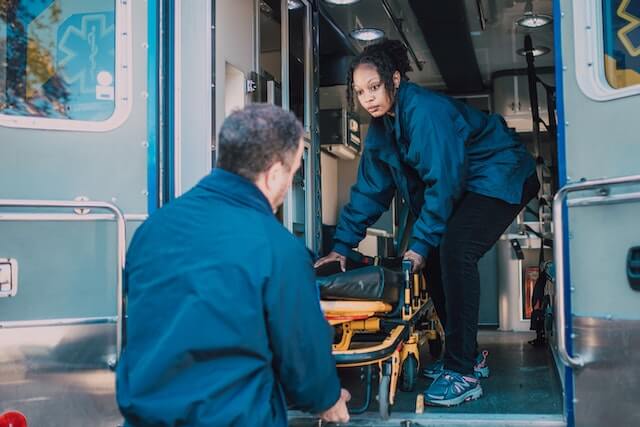
The 000 call taker can talk you through CPR or first aid until paramedics arrive.
- Stay on the line. The call taker can talk you through CPR step by step, including the compression rhythm.
- Follow DRSABCD — check for danger, response and breathing before anything else.
- If the person is unconscious but breathing, roll them into the recovery position.
- If there is a defibrillator (AED) nearby and someone else can fetch it, send them — do not leave the patient yourself.
- Gather the patient’s medications, or the boxes, for the paramedics to take.
- Unlock the front door and clear a path to the patient.
Does an ambulance cost money in Australia?
It depends on where you live. Ambulance services are run state by state, and cover is not the same across the country:
- Queensland — the state government covers emergency ambulance treatment and transport for Queensland residents, including when they travel interstate.
- Tasmania — free for Tasmanian residents within Tasmania. Cover interstate depends on reciprocal arrangements, and does not extend to every state.
- Victoria and Western Australia — a fixed fee applies unless you hold cover or a concession.
- NSW, ACT, South Australia and the Northern Territory — a call-out charge plus a per-kilometre charge.
Cover can be bought as a standalone membership from your state ambulance service, or as part of private health insurance. Concession and pensioner exemptions vary by state. Check what applies to you before you need it — and never let uncertainty about a bill stop you calling 000 in an emergency.
Calling an ambulance and medical IDs
Everything above assumes someone in the room can answer questions about the patient. Often no one can — the patient is unconscious, or the person who called is a stranger, a colleague or a passer-by. A medical ID closes that gap by carrying the answers on the patient themselves.

A medical ID answers the questions paramedics ask when the patient cannot.
A wristband can only be engraved with a few words. With MedibandPlus, the band also carries a membership number that lets first responders access a secure profile holding the wearer’s conditions, medications, allergies and next-of-kin contacts — the same list a call taker asks for. It does not assess or diagnose anything. It simply makes the wearer’s own information available when they cannot speak, so the right care reaches them sooner.
Part of the Mediband family. Designed in Australia since 2004.
Related reading: how to set up your emergency contacts, the full DRSABCD first aid action plan, and the recovery position. When you are ready, you can start a MedibandPlus membership.
Calling an ambulance FAQs
When should you call an ambulance?
Call 000 for an ambulance if someone is unconscious, is having difficulty breathing, has chest pain, is bleeding heavily, shows signs of a stroke, has a seizure lasting over 5 minutes, has a severe allergic reaction, or has been seriously injured. If you are unsure whether it is serious enough, call anyway — the call taker will help you decide.
What do you say when you call 000?
Say “ambulance” when the operator answers, then give your location. After that you will be asked what happened, the patient’s age, whether they are conscious and whether they are breathing. Speak plainly, answer directly and stay on the line.
What information does an ambulance need?
Your exact location, what has happened, and the patient’s age, consciousness and breathing. Paramedics will then want the patient’s existing conditions, current medications and any allergies. If the patient cannot tell them, look for a medical ID, a wallet card or a medication list.
Can you call 000 from a mobile with no credit or no signal?
Emergency calls are free and work without credit, and 000 can be dialled from a locked phone. Coverage is different: if your own network is unavailable, any mobile made since 2002 will already try other carriers' networks when you dial 000. Dialling 112 instead makes no difference — it reaches the same service with no priority — and if no network reaches you at all, no emergency number will connect.
What if I call an ambulance and it turns out not to be serious?
You will not be in trouble. Emergency call takers are trained to assess the situation and would much rather answer a call that turns out to be minor than miss one that is not. If it is urgent but not an emergency, they can also direct you to a 24-hour nurse advice line — healthdirect on 1800 022 222, NURSE-ON-CALL on 1300 60 60 24 in Victoria, or 13 HEALTH on 13 43 25 84 in Queensland.
Should I drive the person to hospital instead?
Not for anything on the emergency list above. Paramedics begin treatment the moment they arrive and can alert the hospital before you get there. Driving yourself also risks the patient deteriorating in the car with no one able to help.
Sources
- Triple Zero (000) — when and how to call Australia’s emergency number.
- healthdirect Australia — calling Triple Zero, and the 24-hour nurse advice line (1800 022 222; NURSE-ON-CALL 1300 60 60 24 in Victoria; 13 HEALTH 13 43 25 84 in Queensland).
- ACMA — how emergency calls, mobile roaming and the 106 text service work.
- Your state or territory ambulance service — for local cover, billing and membership rules.
- Australian Resuscitation Council (ANZCOR) — basic life support guidance.
Disclaimer: This article is general first aid information, not medical advice or a substitute for accredited first aid training. In an emergency, always call Triple Zero (000). For non-urgent health advice, call healthdirect on 1800 022 222 (NURSE-ON-CALL 1300 60 60 24 in Victoria, 13 HEALTH 13 43 25 84 in Queensland) or speak with your GP. MedibandPlus stores and provides access to a member’s own medical information; it does not assess, diagnose or treat any condition.
More first aid guides


